


Added VOACAP for propagation prediction to 3C2MD web page.
The most part of the European HAMs are sure that in case DX’pedition in Africa, the only thing to do is to head the antenna south and waiting looking at the cluster.
Well… sadly they are not completly wrong, since Africa, ionosferically speaking, is the European’s backyard. However, expecially on low bands, it could be convenient to be at the “right place and right time”, just before the pile-up starts.
As their colleagues from the Old Continent, for not-European DX Hunters could be matter of life or death to know what bands are opening before the spirit of cluster evokes of the infamous “European Aluminium Wall”.
The best way to know when is better to be on that specific band rather than another one, is to use the “ionospheric propagation predictions”. To obtain such predictions is not necessary to be involved in some exoteric experience, but rather to take advantage from the big work of Jari, OH6BG, that, since years ago, is developing VOACAP, a software-based system originally created for Voice Of America, the HF Broadcating that spread the American culture world-wide.
Indeed VOACAP is the short for “Voice Of America Coverage Analysis Program”.
From years Jari is fitting this software for the Hamateur Radio community’s needs and his (successful) efforts are well displayed at VOACAP’s web site www.voacap.com.
For who is interested to getting deeper, tons of handbooks, powerpoint presentations, papers and speech are available, but for who is not passionate of physic of the Ionosphere, the “meal-ready-to-eat” is on the dish.
Jari prepared a “tailor made” interface, specific to reach 3C2MD, available at 3C2MD site, from the specific voice on menu “Voacap” (higher right).
Now let us briefly introduce you in how to manage the input mask in order to get better predictions results.
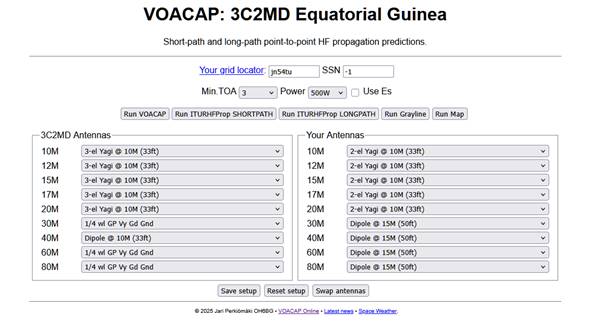
First of all you must say to the software what is your QTH: for that you have to input your grid locator in the dedicated window. If you don’t know where are you (in amateur radio terms), you may click on “Your grid locator” beside the entry window and access to the VOACAP utility “QTH Locator”.
Now let’s go further: just leave SSN default value -1 (so the software will take automatically the necessary updated Sun Spot Number data in the best format available), then also leave the Min TOA (Minimal TAKE OFF ANGLE of your antenna system) at the default value 3 degrees (this is a “one size fit all” value but if you feel that your system is very performant, you are free to choose a different lower value).
Then you should set your Power: Jari just takes in consideration few levels of output power, 5/100/500/1000 Watts.
Evidently a lot of steps after 1000 are missed, however please note the uncommon presence of the level of 5W (says “five-Watts”), dedicated to QRP lovers: prediction of possible QSO window with QRP power will help to focus their efforts at the right moment of the day.
Is time to give to the software the Antenna data of both sides: 3C2MD main antennas are already set as default, so you should just pay attention to only indicate YOUR ANTENNAS. Choose from the list what is the most represenatitve antenna type for each band for your situation. In case of vertical antennas 1/4wave you may even choose type of ground between normal, good and very good.
Now all the data needed was given and it is time to let the software works: immediately above the Antenna entry widow there are several buttons that deliver different output: for our basic purposes the most interesting is “Run VOACAP”, on the far left.
The output will be a page full of charts but the most interesting is the first one, giving for the 24 hours, the Reliability of the QSO between your QTH and 3C2MD, Short Path or Long Path.
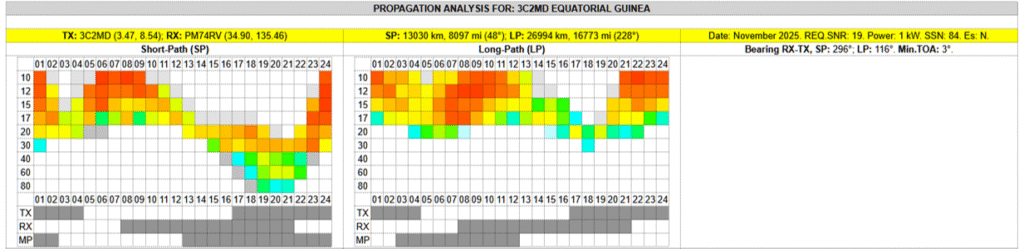
While the Long Path windows is intended for for very far takers, a lot of interesting operating parameters are delivered. However you may interested to have your prognose “at a glance”: as a rule of thumb, the red color is for the most promising period(s) of the day, right down to white-blu, when you should be very lucky to have a chance to contact us!
Please don’t be fooled by TX/RX specification on the upper yellow bar: the propagation between your QTH and 3C2MD is a two-way channel and the results are given for the power level of your TX you entered, regardless of who is formally marked as TX or RX.
For who really wants to be “on the edge”, Jari delivers through our site not only VOACAP predictions, offering also two ITUHFProp predictions: Short-Path and Long-Path. ITUHFProp is a software program developed for HF propagation predictions by the ITU. So, you can have the best of two worlds!
If you like the game, visiting VOACAP website you may do the same for all the places of the world.
Before you go, pay attention to a very useful brand-new feature from Jari: on the far right the button “RUN MAP” will create an Azimuthal map centered on you locator, giving you the exact distance and short path heading for your antenna toward us.
Thank you Jari for al that stuff!