Mykonos (Greek: .......; see also List of traditional
Greek place names) or Myconos is an island of Greece and
one of the top international tourist destinations,
famous largely for its cosmopolitan character and its
intense nightlife. The island is part of the Cyclades,
lying between Tinos, Siros, Paros and Naxos. It spans an
area of 86 km² and rises at an elevation of 364m at its
highest point. The island is composed primarily of
granite. It has little natural fresh water and relies on
the desalination of sea water in order to meet its
needs. There are approximately 6200 inhabitants (2002).
The largest town is Mykonos, also known as Chora (i.e.
the Town in Greek, a common denomination in Greece when
the name of the island itself is the same as the name of
the principal town), which lies on the west coast. It is
believed that the island was named after a local hero,
who is considered an offspring of the god Apollo and was
worshipped locally in antiquity.
 |
History
Archaeological finds indicate that the Ionians
settled on Mykonos in the early part of the 11th
century BC. More recent discoveries have uncovered
remnants in Ftelia beach from the Neolithic Kares
tribe dating back to as far as 3000 BC.
In Greek mythology Mykonos was the location of the
battle between Zeus and the Gigantes, and the island
was named in honor of Apollo's grandson Mykons.
During these ancient times, Mykonos, due to its
proximity to the then highly populated island of
Delos (situated about 2km away), became very
important as a supply island and possibly as a
getaway location for Delian citizens.
|
|
In Greek
mythology Mykonos was the location of the battle
between Zeus and the Gigantes, and the island was
named in honor of Apollo's grandson Mykons. During
these ancient times, Mykonos, due to its proximity
to the then highly populated island of Delos
(situated about 2km away), became very important as
a supply island and possibly as a getaway location
for Delian citizens.
[edit] Modern Mykonos
Today, Mykonos is one of the world's most
cosmopolitan islands, having become increasingly
popular especially during the last 50 years due to
the numerous international jet set visitors that
spend their holidays on the island. It is widely
known for its extremely rich, diverse and often
intense nightlife featured by a vast number of bars
and nightclubs. Mykonos is also distincted for its
sandy beaches, offering everything from
crystal-clear waters, windsurfing potential,
sea-side tavernas, bars featuring 24-hour loud music
and even full nudity in some cases. Many Greek and
international celebrities have summer residences in
Mykonos and can often be seen walking the
white-washed roads or having dinner at a small
street-side table of an expensive restaurant or a
taverna. The island is also one of the most upscale
areas of Greece, and its real estate is very
expensive. The popularity of the island has given
rise to a wave of real estate development with the
construction of private homes, villas, and hotels.
This has raised some concerns that the island may be
gradually losing its character. In order to prevent
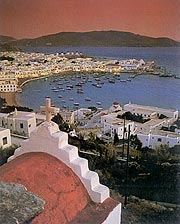
this, the island's zoning requires all new buildings
to abide by the rules of the Cycladic architectural
style. |
 |
 |
Nightlife
The nightlife of Mykonos is marketed as among the
best in Europe. Mykonos is rated among the top
clubbing destinations in the Mediterranean, along
with Ibiza, Ayia Napa and Rimini[citation needed].
Mykonos also attracts world-famous DJs to its clubs
and beach bars, the most well-known of which are
Paradise, Super Paradise and Paranga. In addition,
Mykonos is a gay-friendly resort area during the
summer, featuring several gay clubs. Mykonos
nightlife focuses mainly on bars rather than clubs,
yet there are notable clubs also.
|
|
|
|
Others
photo came after dx-pedition
|
